Arrow Masonry Headquarters · Palatine, IL
Arrow Masonry and Exteriors is headquartered in Palatine at 515A South Vermont Street. The company was registered in Palatine in 1993, and the founders operated a masonry restoration business in the northwest suburbs for over twenty years before Arrow was formed. Arrow serves Palatine condo associations, homeowner associations, property managers, and commercial building owners across the Village's full masonry building stock, from Village-of-Palatine-era historic structures near the Northwest Highway downtown core, to Palanois Park post-war residential, to newer commercial and multi-family construction. Local crews dispatch directly from the Palatine office; property managers and condo boards inside a fifteen-minute radius routinely receive same-day or next-day walk-through estimates.
What We Do in Palatine
Palatine's masonry building stock spans over 150 years, from Village-of-Palatine-era buildings that predate 1900 to Palanois Park single-family and postwar multi-family properties. Mortar retreatment intervals run on the same 15-to-20-year cycle regardless of construction date, and the Chicago-area climate delivers roughly 100 freeze-thaw cycles per year on every elevation. Arrow grinds each joint to a minimum three-quarter-inch depth before packing new mortar, and color-matches every batch from a physical sample taken against the wall being repaired. Palatine crews reach most Village neighborhoods within twenty minutes of leaving the Vermont Street shop.
Tuckpointing ›Spalled, cracked, and displaced brick on Palatine buildings are water entry points, not cosmetic problems. Village-era historic buildings often use common brick from Chicago-area kilns that closed decades ago; salvage sourcing through regional brickyards is frequently the only viable path for matching replacement units. Postwar Palanois Park and commercial buildings use later manufacturing standards that are more readily matched. Arrow locates matching material before committing to the repair, tuckpoints the surrounding joints as part of the same scope, and hand-selects each replacement unit so face color, texture, and dimension read continuous with the original wall.
Brick Repair ›When a Palatine building needs more than spot repairs, Arrow provides a full envelope assessment and a phased restoration plan. The assessment covers mortar joints, brick and stone faces, lintels, sills, coping stones, parapet caps, flashing, and roof-to-wall transitions. Priorities are assigned by water-entry risk and structural urgency so condo boards and property managers can fund critical work now and budget deferrable work over the next twelve to twenty-four months. Every scope includes a written specification suitable for reserve-study review, Village of Palatine permit filings, and lender documentation.
Masonry Restoration ›Every masonry window and door opening is supported by a lintel that carries the brick load above it. In Village-of-Palatine-era buildings and older commercial structures on Northwest Highway, original steel lintels have had 60 to 100+ years of water exposure and are typically rusting from the inside out long before visible cracking appears at the surface. Rusting steel expands up to ten times its original volume, which fractures the surrounding brick and mortar. Arrow replaces failed lintels before the deterioration reaches the surrounding masonry; at the point of surface failure, a lintel replacement becomes an opening rebuild.
Lintel Replacement ›Palatine's older commercial and civic buildings, including landmarked structures like the George Clayson House (1873) and Cutting Hall, incorporate limestone and cast stone in sills, water tables, string courses, and facade accents. Stone requires different techniques than brick: softer mortar composition, protective grinding protocols, and breathable consolidants for friable or delaminating material. Arrow handles both the stone repair and the surrounding masonry integration so restored sections read as continuous with the original facade, and uses lime-based mortars on historic buildings where Portland-based mortars would trap moisture and accelerate stone loss.
Stone Restoration ›Chimneys are the most exposed masonry element on any Palatine building, unprotected on multiple sides, hit directly by every rain event, and cycled by freeze-thaw without the benefit of wall insulation. Arrow handles crown repair and replacement, chimney cap installation, tuckpointing, flashing repair, and full chimney rebuilds for Palatine single-family homes, condo associations, and multi-family properties. Chimney base flashing is inspected on every scope, not just crown and joints, since flashing failure is the most common source of water entry on flat-roofed multi-unit properties.
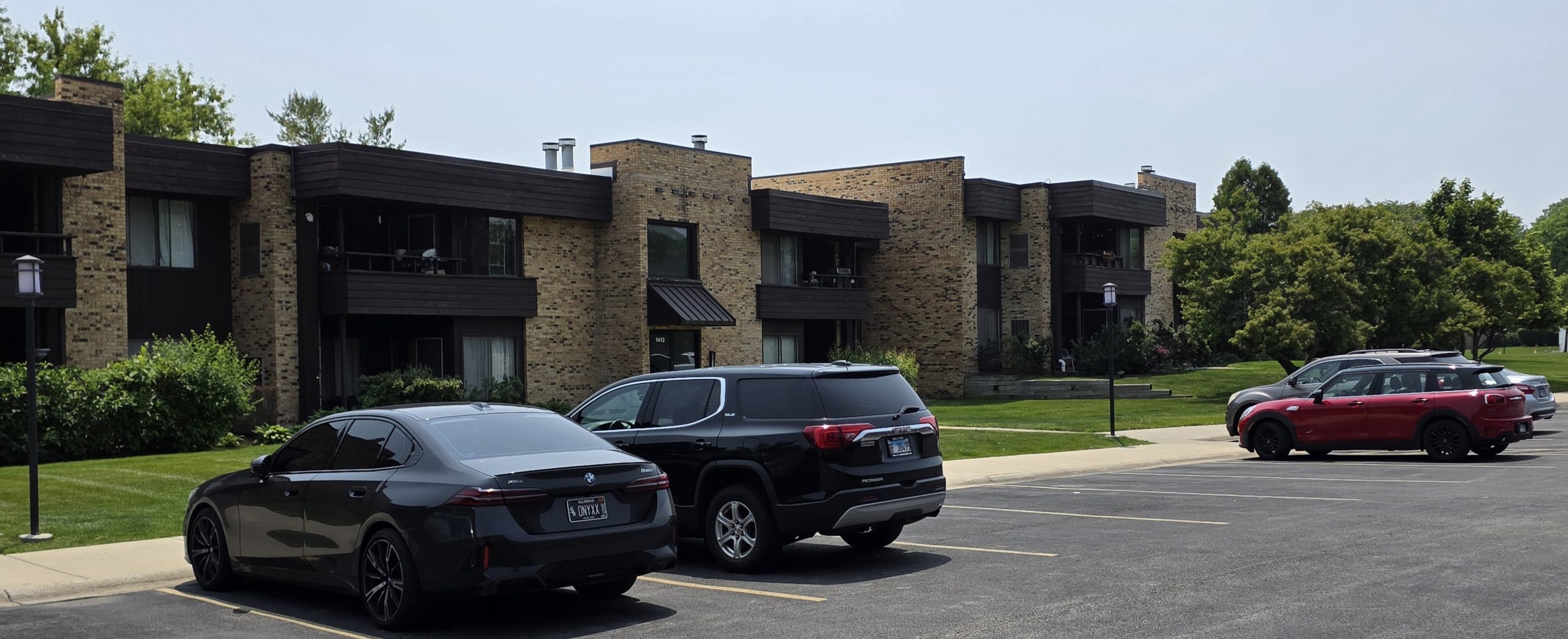
Chimney Repair ›Postwar and mid-century condo and apartment properties across Palatine frequently use panel brick construction: two-to-four-inch thin brick applied to a concrete or steel frame, with an air cavity behind the panel. Panel systems fail differently than solid masonry: anchor corrosion causes bowing, and eventual separation becomes a life-safety hazard. Arrow uses stainless-steel through-bolt anchors on panel repairs for a service life of 50 years or more, coordinates with structural engineers where anchor loading requires analysis, and preserves the weep holes that panel systems require to drain properly.
Panel Brick Repair ›Local Context
Arrow Masonry and Exteriors was registered in Palatine in 1993 and has operated from the Vermont Street office continuously since. The founders operated a separate masonry restoration business in the northwest suburbs for over twenty years before Arrow was formed. Combined field experience across the founding team exceeds fifty years.
Local crews dispatch directly from the Palatine shop. Property managers and condo boards within roughly a fifteen-minute drive of the Vermont Street office routinely receive same-day or next-day walk-through estimates when weather permits. Written scopes typically follow within seventy-two hours.
Arrow is licensed, insured, and bonded for masonry work throughout the Village of Palatine, Cook County, and the surrounding northwest suburbs.
The Village of Palatine requires permits for structural masonry repair, tuckpointing above a locally set height threshold, parapet-wall work, and any work involving lintels. Permit filings require contractor licensing information, insurance certificates, and workers' compensation documentation. Village staff review submittals through the Community Development Department.
Arrow files permits directly on behalf of clients on most Palatine projects. Larger scopes involving multiple work types are often filed as a single coordinated permit rather than separate applications.
Mortar work requires ambient temperatures above 40 degrees Fahrenheit during placement and the initial twenty-four-to-forty-eight-hour cure. Chicago-area weather reliably meets this threshold only from mid-April through early November. Emergency stabilization can be performed year-round with heated enclosures and mortar additives; scheduled maintenance tuckpointing, brick replacement, and full restoration are planned in the standard working season.
The Village of Palatine was incorporated in 1866 around the Chicago and North Western Railway station. Buildings from the Village's first fifty years, including the George Clayson House (1873), Charles H. Patten House, and Cutting Hall, are among the historic masonry structures in the Village. Wood Street, named for founder Joel Wood, anchors part of the original downtown.
Historic buildings require heritage-appropriate mortars. Lime-based mortars, rather than modern Portland-based mixes, are used on pre-1930 structures to preserve the wall's ability to breathe and to protect softer historic brick from spalling. Arrow prepares mortar samples for material analysis when historic-appropriate specifications are required.
Arrow custom-blends mortar and samples it against the existing building before a single joint is filled. Completed repairs integrate into the facade instead of announcing themselves as patches.
Arrow separates critical repairs from work that can wait twelve to twenty-four months. Boards fund essential work now and budget secondary work in future cycles, without deferring what is structurally necessary.
Property managers are accountable to residents and boards. Arrow communicates schedule adjustments and scope changes in writing before they take effect, not after a crew fails to appear.
What Clients Say
Excellent response to my questions very pleased with the results.
They did an excellent job… it was not nearly as messy as I had anticipated. The crew cleaned up afterward, so much so that you would have never known they were here!
ARROW provided assistance in determining the problems with the masonry work at the fire station. Scheduling was excellent and they were there when they said they would be there. Excellent clean up… Kept job site in good order… Would rehire for other projects!
I wanted to thank you for having an extremely professional tuckpointing crew do the work on my home. Stanley and his crew were prompt and courteous. After making unavoidable dust, they cleaned up the area and made sure that the home was presentable again. It is unusual to see this kind of workmen anymore and I want to express my gratitude to your company for selecting such good workmen to represent your company
Full Service Capabilities
Arrow also helps property owners correct municipal code violations and failed facade inspections. Request a quote online 24/7 or call (847) 776-6400. Arrow can usually schedule an on-site inspection within 24 hours.
Free estimates for all projects. We serve property managers, condo associations, and building owners across Palatine and Cook County.